|
Getting your Trinity Audio player ready...
|
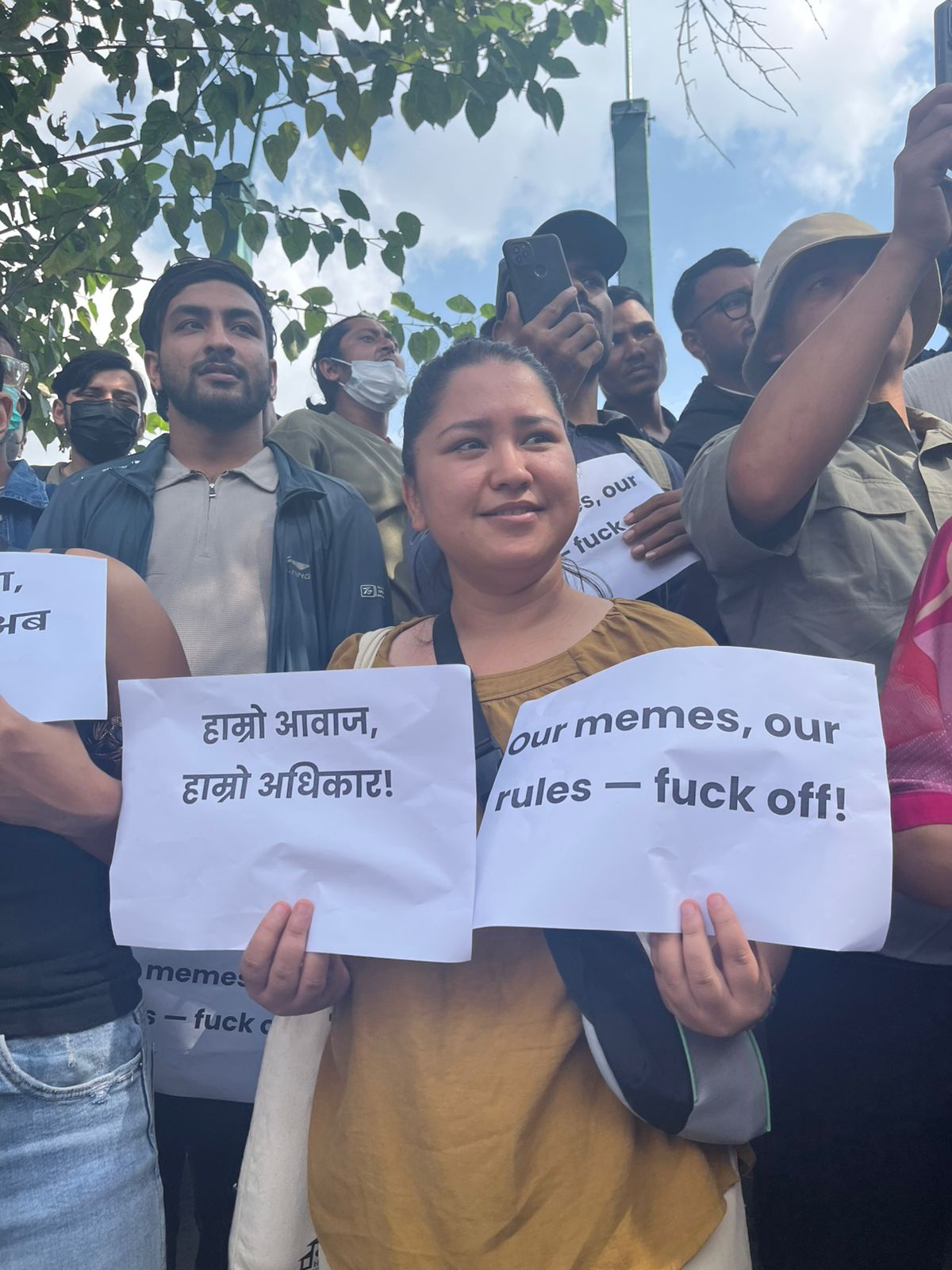
I arrived at Maitighar Mandala just after 9 a.m., where the air buzzed with the energy of hundreds of young protesters. Many were still in school and college uniforms, holding hand-painted placards: “Youth Against Corruption” and “Stop Looting the Nation.” Others carried banners mocking the so-called “nepo babies” — the children of Nepal’s political elites flaunting wealth online while ordinary youth struggled with unemployment. The crowd’s anger was palpable, fed by weeks of online mobilization, combined with the government’s ban on social media platforms.
By 9:30 a.m., the crowd had swelled to over a thousand. Small groups moved in formation, waving flags and singing “Rato ra Chandra Surya, Jangi Nishana Hamro.” Some carried portable loudspeakers, while others shouted slogans calling for accountability from Prime Minister K.P. Sharma Oli, Congress President Sher Bahadur Deuba, and Communist Party leaders.
10:00–10:30 a.m. — The March Toward Baneshwor
At 10 a.m., the protesters began moving toward New Baneshwor, chanting “No to corrupt leaders!” and “Revoke the social media ban!” The march was largely orderly but determined, with students from as young as eighth grade marching alongside university students. By 10:30, we reached Bijuli Bazaar, where tensions escalated. Protesters hurled bottles at a billboard displaying Prime Minister Oli’s portrait. One young man climbed the pole and tore it down amid cheers from the crowd. Police attempted to disperse the demonstrators with water cannons, briefly scattering them, but the crowd quickly reassembled, undeterred.
11:00–11:30 a.m. — Scaling Bridges and Defying Boundaries
By 11:15, several protesters had climbed an overhead pedestrian bridge near Baneshwor, unfurling a banner that read: “Time Is Now — Wake Up, Nepal.” The group pressed past traditional protest boundaries, entering zones that had historically been restricted. The scene was electric — a mixture of determination and raw anger.
By 11:45, demonstrators reached New Baneshwor, past the point where authorities had previously stopped marches. They began scaling the main gate of Parliament, waving the national flag from a security post while chanting slogans. The crowd below surged forward, adding to the momentum.
12:00–12:30 p.m. — Tensions Explode
Police responded with tear gas. Thick smoke clouded the compound, stinging eyes and throats. Some protesters hurled stones and attempted to breach the Parliament’s perimeter wall. Observing from the edge, I could see faces streaked with dust and tears, young people shouting, some shielding classmates from flying debris. The air was heavy with tension and the smell of smoke.
By 12:30, small groups had scaled portions of the perimeter wall. Stones and bricks flew as gaps widened. The crowd’s chants grew louder: “Down with corrupt leaders!” and “Justice for Nepal!”
12:45–1:30 p.m. — Wall Breaches and Gunfire
At 12:45, a section of the wall near the water tank road collapsed, allowing several protesters to enter the Parliament compound. Almost immediately, police opened fire. Gunshots echoed across New Baneshwor. Witnesses carried wounded protesters down side streets; others strapped them to motorcycles for emergency transport. Blood stained the asphalt, and tear gas clung to every surface.
I followed one stretcher carrying a student in a school uniform, his shirt soaked with blood. At Civil Hospital, dozens were being treated, many with gunshot wounds. At Bir Hospital Trauma Center and Everest Hospital in Baneshwor, more than 100 injured patients arrived in a constant stream, some barely conscious.
Afternoon — Hospitals and Streets in Chaos
By 2:00 p.m., protesters approached police lines again, hands raised, pleading for restraint. Shots rang out, scattering the group. Tear gas spilled into hospital grounds, disrupting emergency care. Ambulances struggled to move through clogged streets.
Authorities imposed curfews across Baneshwor, Singha Durbar, the President’s residence area, and other major cities including Pokhara, Butwal–Bhairahawa, and Itahari. Residents were warned not to leave their homes or observe the protests from rooftops.
Casualties and Political Fallout
According to the Ministry of Health and Population, 19 people were killed nationwide, and 347 others injured. Civil Hospital reported three deaths among 100 patients; Bir Hospital and the National Trauma Center reported eight fatalities. Everest Hospital treated 102 patients, reporting three deaths.
By Monday evening, Home Minister Ramesh Lekhak resigned, citing moral responsibility for the crackdown. His resignation followed intense pressure from within his party and from the public after one of Nepal’s deadliest police responses in recent years. Prime Minister Oli chaired a cabinet meeting at Baluwatar as criticism mounted over the government’s handling of the protests.
